The Most Expensive Words in Finance
Words shape how we see the world, and how we see the world shapes how we act. Psychologists have long observed that the same situation, described in two different ways, can lead the same person to make two different decisions.
That's true in medicine, in advertising and in everyday life. And it's true of money, perhaps more than anywhere.
Why language matters with money
Financial news is often written to grab attention. Some financial products are marketed in ways designed to make us feel anxious or excited. And the way we talk to ourselves about money is built from words we've picked up along the way.
Not all of those words are helpful. Some prompt feelings that can drive decisions more than the facts do. Being aware of them doesn't change the risks involved, but it can help us see those risks more clearly.
A few words worth a second look
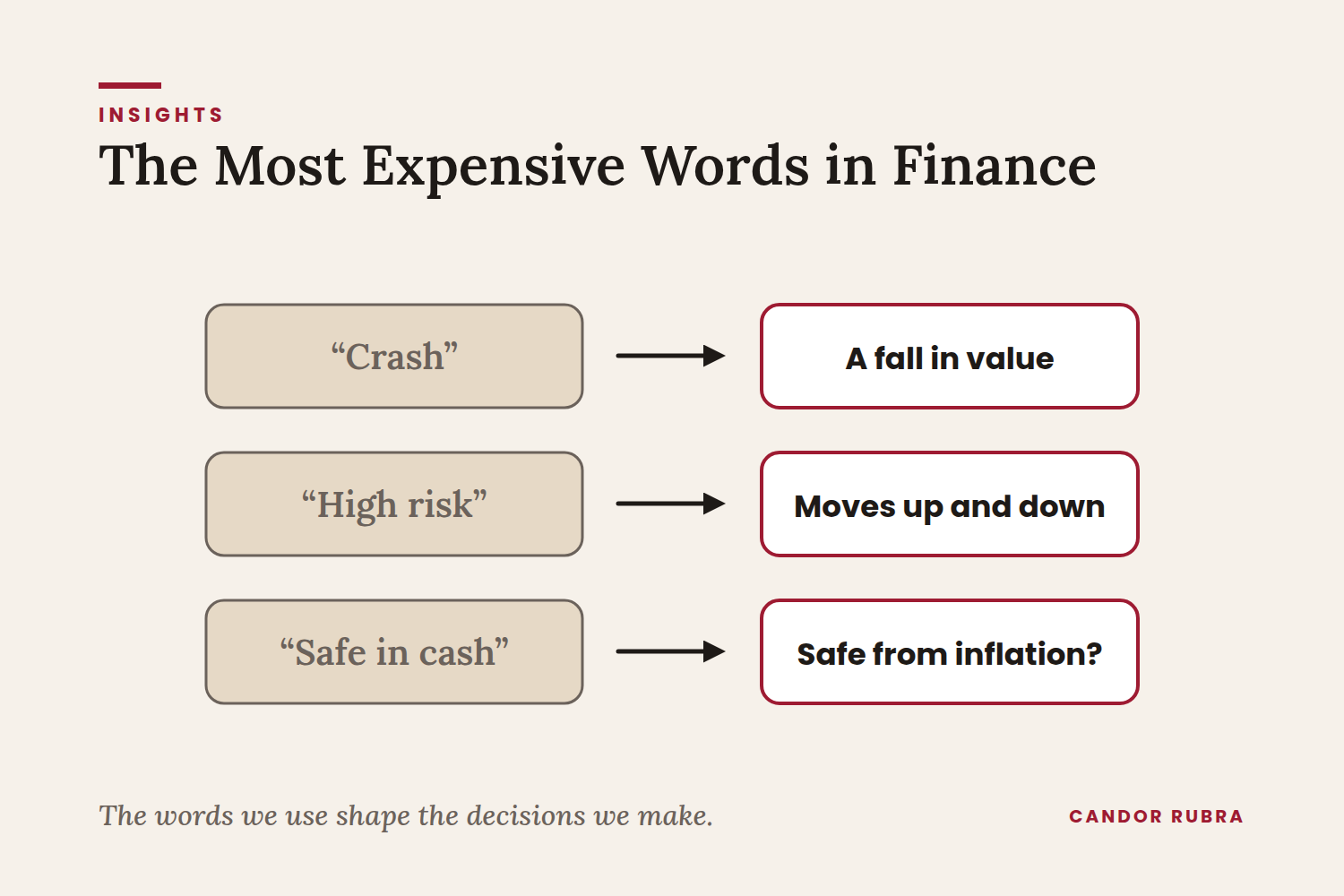
Crash. Falls of 10 to 20% are often described as a crash, a word that suggests lasting damage. Falls of this size have historically been a relatively regular part of investing, and many have been temporary. Some, though, have been deeper and taken years to recover, and there's no guarantee that any fall will be short-lived.
High risk. Risk labels usually describe how much an investment's value can move up and down, particularly in the short term. That volatility is real and it matters, especially for money that may be needed soon. But it's only part of the picture. Over longer periods other risks come into play too, such as inflation reducing the value of money that isn't growing. Looking at all of these risks, rather than a single label, gives a more complete view.
Safe in cash. Cash offers security of capital and doesn't fluctuate in value, which is exactly why it has an important role, for example as an emergency fund. But 'safe' doesn't tell the whole story. Over time, inflation can erode what cash can buy. Cash protects the number, not necessarily what the number can buy.
"I've paid for life cover for twenty years and never claimed." It's natural to feel that premiums without a claim have been wasted. Another way to see it is twenty years in which your family had protection in place, should the worst have happened.
The stock market. The phrase can sound remote, even a little like a casino. In reality, owning shares means owning small parts of businesses that make and sell real things to real people, although, as with any business, their value can fall as well as rise.
Drawing down your pension. The phrase can sound as if something is draining away. Another way to see it is paying yourself an income from decades of saving. That said, how and when you take pension income is an important decision with long-lasting consequences.
Where that leaves you
Simply noticing the language used in headlines, in brochures and in our own self-talk can take away some of its power.
Having someone to talk things through with can help too. Part of what a financial adviser does is translate the noise into a clearer, balanced picture of what's actually happening, so that decisions can be based on facts and your own circumstances rather than on feelings someone else has chosen for you.
Important information
This article is for information purposes only and does not constitute financial advice, which should be based on your individual circumstances. The information provided is subject to the UK regulatory regime and is therefore primarily targeted at consumers based in the UK.
The value of investments and any income from them can fall as well as rise. You may not get back the full amount invested.
While cash provides security of capital, it may not keep pace with inflation. Over time, the real value of your savings could fall.
The value of pensions and any income from them can fall as well as rise. You may not get back the full amount invested. A pension is a long-term investment and the value is not guaranteed. Your pension income could also be affected by the interest rates at the time you take your benefits.
Drawdown pension plans (unsecured income) are complex and are not suitable for everyone. Pension decisions can affect your income for the rest of your life (and that of any partner and other dependants). Where benefits are accessed on a flexible basis, these are not fixed or safeguarded for life.
Cover will cease if premium payments are not maintained. Generally, these plans have no cash in value at any time and will cease at the end of the term.