Dead Money, Living Money
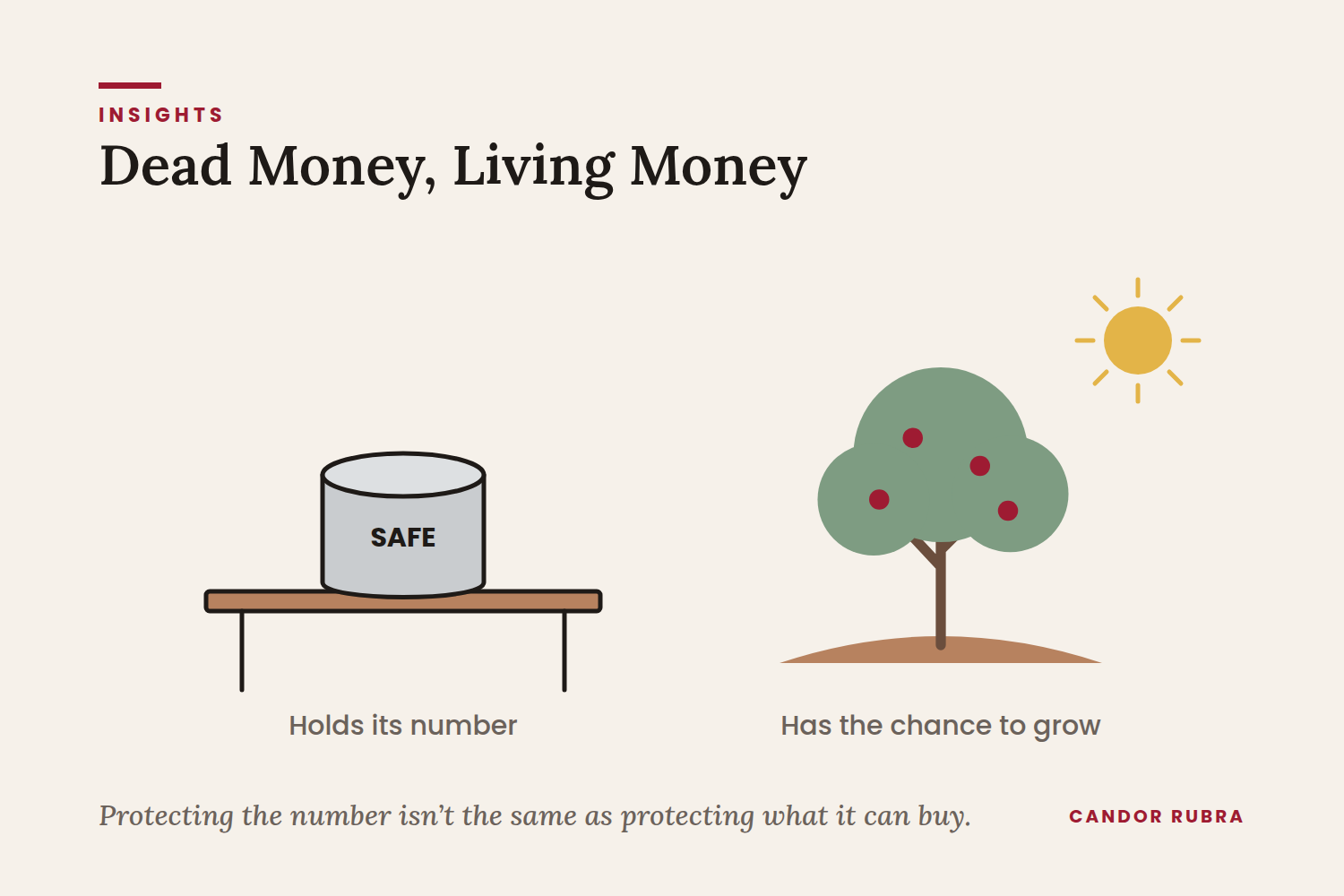
Imagine a handful of seeds. You could plant them in the garden, where they'll face wind, rain and the occasional frost. Or you could keep them in a tin on the shelf, where nothing can touch them.
The tin feels like the careful choice, because the seeds stay exactly as they are. The garden is less predictable, and not every seed will take. But given time, the garden is where growth can happen.
Money can be thought about in a similar way. Many people's first instinct is to keep hard-earned money somewhere it won't move around. That instinct is understandable, and there are times when it's exactly right. But it's worth understanding what it can cost over the long term too.
The stewardship instinct
When money has been hard-won, we naturally want to look after it. But protecting the number in an account isn't always the same as protecting what that money can buy.
A useful way to think about money is in terms of purchasing power: its ability to pay for the life you want, now and in the future. Inflation is one of the main threats to that, and it raises an important question:
"Where can money be held so that its future purchasing power has the best chance of being maintained?"
There's no single answer, and different assets play different roles.
Assets that hold still, and assets that grow
Some assets tend to hold their value in money terms but may struggle to keep up with inflation over long periods. Cash is the obvious example. It provides security of capital and easy access, but its real value can fall over time. Bonds typically pay a fixed income that inflation can erode, although they can offer stability and diversification. Gold produces no income, though some people hold it as a store of value.
None of these is a 'bad' asset. Each can have an important role, whether for money needed in the short term, as an emergency fund, or to reduce the ups and downs of a wider portfolio.
Other assets are designed to grow. Shares in companies, known as equities, represent part-ownership of businesses that sell products, earn profits and may pay a rising income over time. Over long periods, global equities have historically tended to outpace inflation, although this isn't guaranteed and there have been extended periods when they haven't.
Why the tin often feels better
If growth assets have tended to do better over the long term, why do so many people prefer to keep their money still?
Largely, it's about how investing feels. Shares go up and down, sometimes sharply, and those falls can be unsettling, particularly in uncertain times. Our instincts evolved to spot danger, not to sit calmly through a market fall.
Against that, cash can feel far more comfortable, because tomorrow's value will be almost identical to today's. The cost, inflation's gradual effect, is quieter and easier to overlook.
Finding the balance
For most people the question isn't 'tin or garden' but how much of each, and for what purpose. That depends on goals, timeframes, how much volatility someone is comfortable with and how much they could afford to lose. Getting that balance right can make a real difference to long-term plans, and it's an area where personal advice can help.
Important information
This article is for information purposes only and does not constitute financial advice, which should be based on your individual circumstances. The information provided is subject to the UK regulatory regime and is therefore primarily targeted at consumers based in the UK.
The value of investments and any income from them can fall as well as rise. You may not get back the full amount invested.
Investing in shares should be regarded as a long-term investment and should fit in with your overall attitude to risk and financial circumstances.
Past performance is used as a guide only; it is no guarantee of future performance.
While cash provides security of capital, it may not keep pace with inflation. Over time, the real value of your savings could fall.