After the Gold Rush: The Problem With Chasing Recent Winners
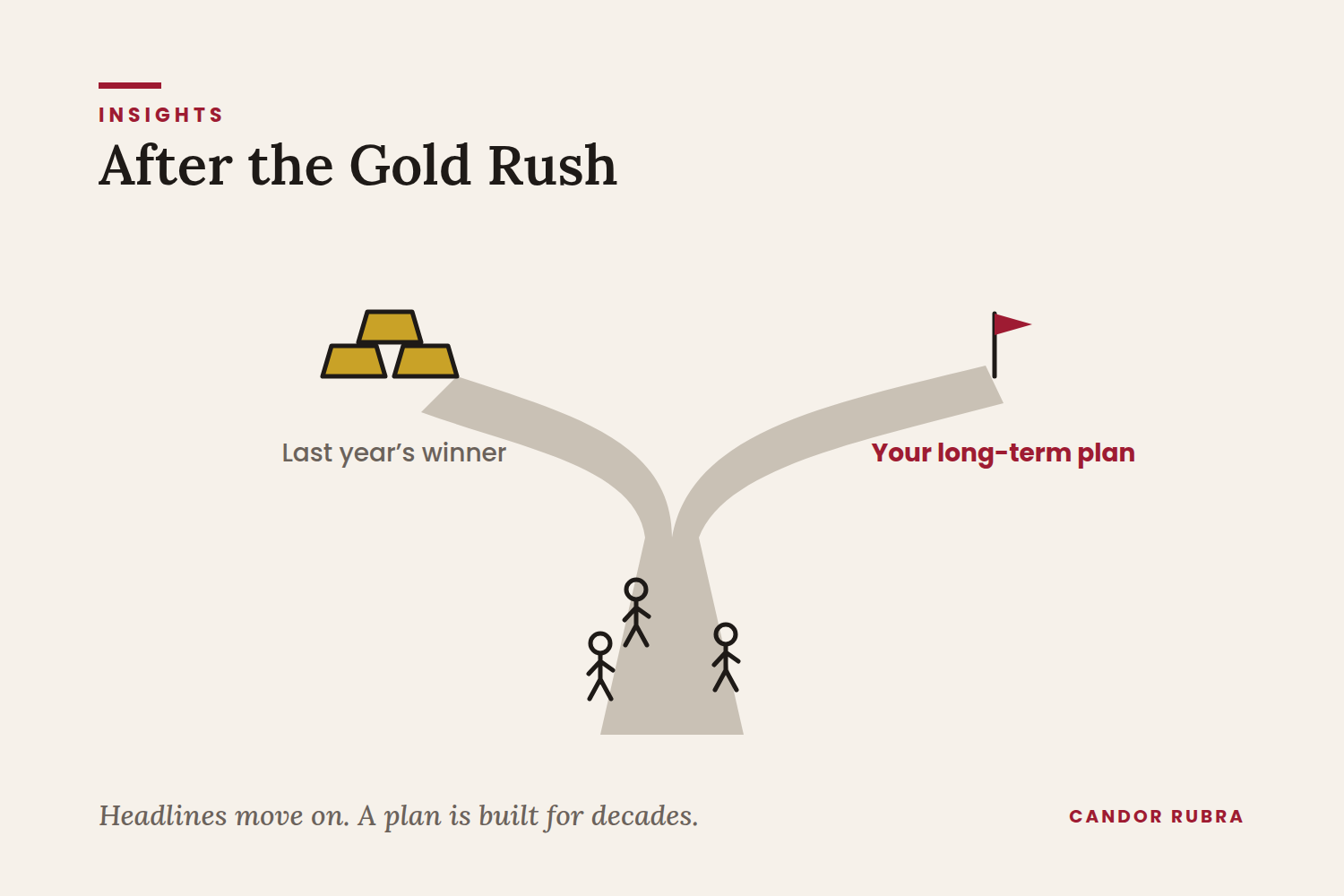
When an asset has a remarkable run, it tends to dominate the headlines. Gold and silver have had that treatment in recent times, with record prices and plenty of media attention.
It's natural to wonder whether you should have owned more, or whether you're missing out.
That feeling is understandable. Precious metals feel tangible in a way that a share in a global fund may not, and gold has been seen as a store of value for thousands of years. The story is simple and appealing: when the world feels uncertain, own something you can hold.
This article isn't a view on whether gold will rise or fall from here. It's about how to think about recent winners more generally.
The hindsight trap
Hindsight bias is our tendency, after the event, to feel that what happened was obvious all along. At the time, it rarely is. For every asset that surges, others disappoint, and before a rally the case for it is usually far less clear than it looks afterwards.
Capturing a large gain from any single asset typically means having made a large, concentrated bet before the rise began, with no way of knowing it would pay off.
Survivorship bias plays a part too. We hear about the bets that worked. The ones that didn't rarely make the news.
Different assets, different roles
There's a fundamental difference between owning commodities and owning businesses.
Gold and silver have practical uses, from jewellery to electronics. As investments, though, they produce no income, no profits and no dividends, and physical holdings can involve storage and insurance costs. Their value depends on what others are willing to pay, and the reasons people hold them can change over time. Gold has spent long periods out of favour as well as in favour.
Shares represent ownership in companies that make products, serve customers and aim to generate profits. Their value can also fall, sometimes significantly, and individual companies can fail. But over time, businesses as a whole have tended to adapt to changing conditions.
It's also worth knowing that broadly diversified global equity funds often include mining and commodity-related companies, so some investors may already have indirect exposure, depending on what they hold.
Process over prediction
Commodities can play a role in some portfolios, and different people will reach different views. The broader point is that decisions based mainly on recent performance can mean buying after much of a rise has already happened.
An alternative many people take is to build a diversified portfolio designed around their goals and timescales, and to review it regularly, rather than trying to predict which asset will lead next. The headlines will always move on to a new 'hot' asset.
If recent headlines have prompted questions about your own investments, professional advice can help you consider them in the context of your wider plans.
Important information
This article is for information purposes only and does not constitute financial advice, which should be based on your individual circumstances. The information provided is subject to the UK regulatory regime and is therefore primarily targeted at consumers based in the UK.
The value of investments and any income from them can fall as well as rise. You may not get back the full amount invested.
Investing in shares should be regarded as a long-term investment and should fit in with your overall attitude to risk and financial circumstances.
Past performance is used as a guide only; it is no guarantee of future performance.