If you or a family member hold the Octopus Inheritance Tax Service, you may have heard that Fern Trading, the company the service invests in, is being split in two.
This article sets out what Octopus has announced, how Business Relief (often still called business property relief) works, and some of the questions the change raises for inheritance tax planning. It is based on the information Octopus has published, as at 9 October 2026. Some details have not yet been confirmed and may change. It isn't a view on Octopus's decision or on how either part of the business will perform.
A quick reminder: what is Business Relief?
Business Relief is an inheritance tax relief on certain business assets, including shares in many unquoted trading companies. It used to be known as business property relief, and you'll still see both names.
In broad terms, qualifying shares can be passed on with full or partial relief from inheritance tax, as long as they have been owned for at least two years and are still held at death. Since 6 April 2026, full relief has been limited to the first £2.5 million of qualifying business and agricultural property combined, with 50% relief above that.
Some investment services, such as the Octopus Inheritance Tax Service, are designed to invest in companies that the provider expects to qualify. That qualification isn't guaranteed, and it depends on the companies continuing to meet the rules.
What Octopus has announced
According to Octopus's published information for investors:
Two share classes. Fern Trading Limited is being split into two share classes, with the working names Fern A and Fern B. Existing investors receive shares in both automatically. Final names are still to be confirmed.
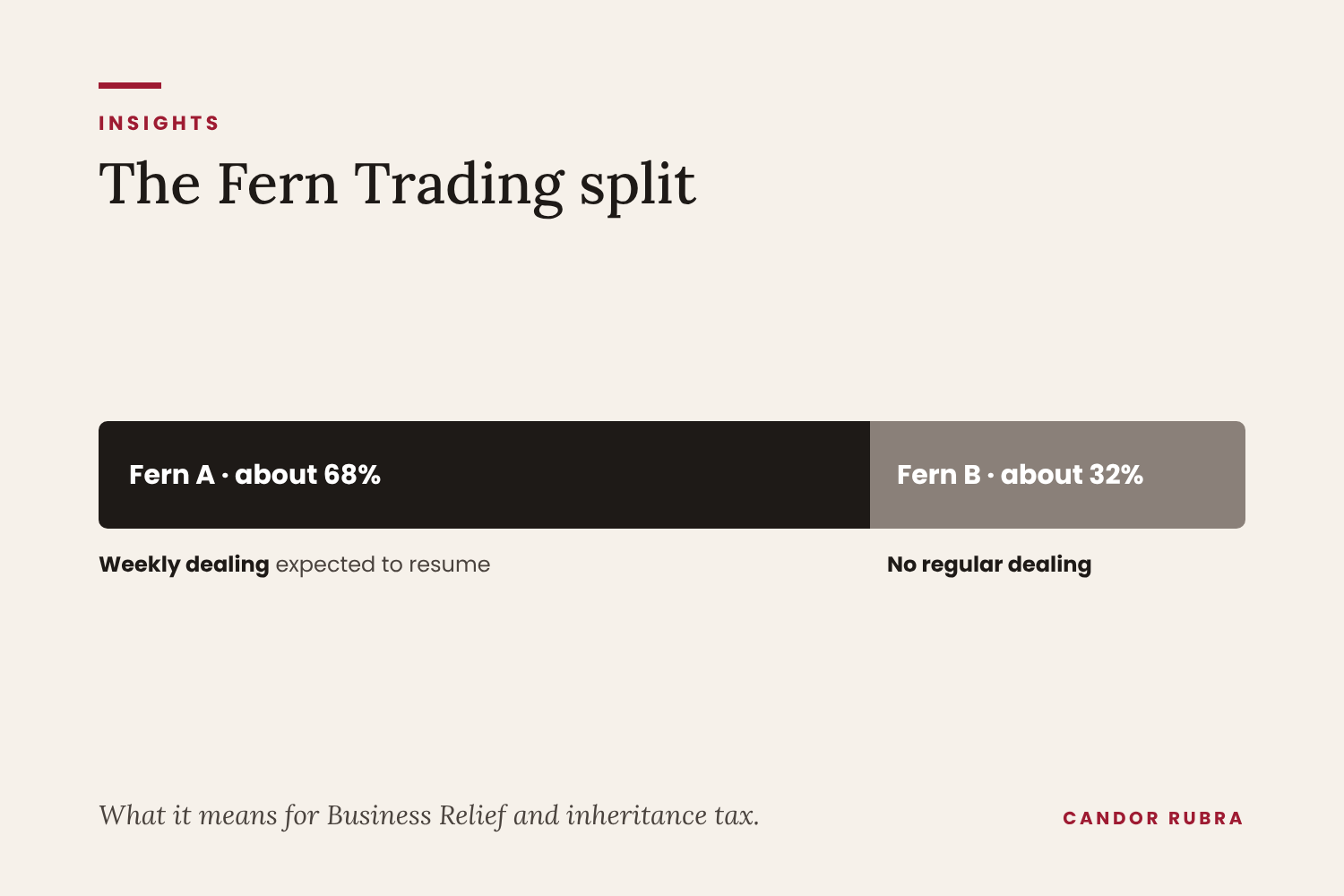
Fern A (about 68% of the value at the split). This holds renewable energy, real estate, property lending and Vorboss, a Central London fibre business. Octopus expects weekly dealing to resume after a transition period, although it notes that, as an unquoted company, liquidity can't be guaranteed.
Fern B (the remaining 32% or so). This holds the wholesale fibre network business plus cash reserves. It is closed to new investment and will not offer routine withdrawals or a regular dealing facility. Octopus says cash will be returned as assets are refinanced, sold or otherwise realised, with no guaranteed timing.
A transition period. Octopus expects this to last around 90 days, though it describes this as an expectation rather than a guarantee. During this time, withdrawals are limited to the Fern A value, and existing withdrawal requests need to be reconfirmed by advisers. After the transition period, Octopus expects to introduce a 90-day notice period for new withdrawals, and notes that this doesn't guarantee payment immediately after 90 days.
Fees. Octopus has said it is waiving its annual management charge. This is separate from its service fee: for Fern A, the service fee remains unchanged, while for Fern B it is deferred and only payable in certain circumstances.
Dealing in Fern Trading shares has been paused since July 2026, while a potential transaction involving the fibre business was explored. Octopus has said that this concluded differently from what it originally expected.
Does the split affect Business Relief?
Octopus has said it expects both Fern A and Fern B to continue to qualify for Business Relief, and that there should be no change to the two-year qualifying period. In other words, the time investors have already held their shares is expected to count.
Two caveats are worth knowing:
Business Relief qualification is assessed company by company, and Octopus notes that it can't be guaranteed.
The tax treatment of the later legal separation of the two parts has not yet been confirmed.
It also helps to separate two questions that are easy to blur together: whether an investment qualifies for relief, and whether you can get your money out. Business Relief generally depends on the shares still being held at death. So not being able to sell part of a holding doesn't, by itself, remove the relief. It does affect access, which can matter a great deal in other ways.
What it could mean in practice
How much the split matters will vary from person to person. A few of the ways it could make a difference:
Withdrawals. Anyone taking regular withdrawals, or planning to draw on the money, may only be able to access the Fern A part for now. Because Octopus has asked advisers to reconfirm existing withdrawal requests, investors with an existing withdrawal instruction may need to take action. Octopus expects regular withdrawals to resume, but the Fern B portion has no regular dealing.
Estates and executors. Where an investor has died, or does in future, executors may be able to sell Fern A shares, subject to dealing being available. The Fern B shares may need to pass to beneficiaries as they are, or be held until cash is returned. That could affect how and when an estate is settled.
Value. Octopus says Fern A will be valued quarterly, and Fern B is expected to be valued at least annually. Octopus has also said it hasn't yet been able to establish a fair value for the assets in Fern B, so for now Fern B is shown at its last valuation, from 1 July 2026. Its value will depend on what happens to the fibre business. The two parts may perform differently from here, and values can fall as well as rise.
Continuing to hold. For someone who always intended to hold until death and has other money to call on, the practical impact may be smaller. For others, it may be larger, and some, such as those with existing withdrawal instructions, may need to take action.
There are a range of options, each with pros and cons, and what's appropriate depends on individual circumstances. Much of the detail is still being confirmed, so for many investors there may be time to consider their position, although some may need to act sooner, for example where they have an existing withdrawal instruction.
The wider lesson for Business Relief investing
Whatever you think of this particular situation, it's a useful reminder of how Business Relief investments work more generally:
They usually invest in unquoted companies, which are generally higher risk than shares listed on a stock exchange.
Unquoted shares can be hard to sell. Providers usually aim to offer regular dealing, but can't guarantee it, and dealing can be paused.
Values can fall as well as rise, so the amount passed on could be less than what was invested, even after the relief.
Holding a large part of your money in a single service concentrates risk.
The rules can change, as they did in April 2026.
The tax relief is only one part of the picture. Access, risk and how an investment fits alongside everything else matter too.
If you hold the Octopus Inheritance Tax Service
Octopus has published a full question-and-answer page for investors at octopusinvestments.com/oits-changes, which is a sensible first place to look. If you have an adviser, they will be receiving updates directly from Octopus and can talk through what the changes mean for you.
If you'd like an independent view on your own position, or on inheritance tax planning more generally, professional advice can help assess what's appropriate based on your individual circumstances. Our team of independent financial advisers is happy to talk it through.
Important information
This article is for information purposes only and does not constitute financial advice, which should be based on your individual circumstances. The information provided is subject to the UK regulatory regime and is therefore primarily targeted at consumers based in the UK.
The information about Fern Trading and the Octopus Inheritance Tax Service is taken from Octopus Investments' published investor information as at 9 October 2026 and may change. It is not a recommendation to buy, sell or hold any investment.
The value of investments and any income from them can fall as well as rise. You may not get back the full amount invested.
Investments that aim to qualify for Business Relief typically invest in smaller or unquoted companies. These are higher risk and can be harder to sell than shares listed on a stock exchange. Business Relief qualification is not guaranteed.
Levels and bases of, and reliefs from, taxation are subject to change and their value will depend upon personal circumstances.
The Financial Conduct Authority (FCA) does not regulate Inheritance Tax Planning or Trust Advice.
Candor Rubra Financial Ltd is an Appointed Representative of ValidPath Limited which is authorised and regulated by the Financial Conduct Authority, Firm Reference Number 197107.
Read More Articles